Upwork Alternatives for Freelancers
Looking for Upwork alternatives? Discover 10 freelance platforms with lower fees, faster payouts, and better client matches.
When you think of freelance marketplaces, Upwork is probably one of the first names that pops up. It’s a go-to platform for professionals, offering a competitive space where major clients like Airbnb and Microsoft search for talent. But for new freelancers, standing out can be a real struggle. Plus, Upwork charges a hefty 10% fee on every project, cutting into your earnings.
If you’re ready to explore better options, you’re in the right place. In this post, you’ll find the 12 best alternatives to Upwork that can help you boost your freelance career.
What is Upwork?
Upwork is one of the best freelancing marketplaces with an active membership of 18 million freelancers.
The number of clients on the platform is 851,000 according to the latest data:

How does Upwork work?
Upwork’s working system is based on “Bidding”.
- Clients post a job advertisement with details of the project, deadline, and budget.
- Freelancers send a proposal with the demanded price, the date they can deliver, and details.
And the client evaluates the offers and hires the freelancer accordingly.
The Platform’s Top features for freelancers
- Upwork’s AI UMA helps you with proposal writing.

One of Upwork’s best features for freelancers is its AI support.**** It’s free and you can ask UMA questions about project details and chat about how to improve your proposal.
- Create a portfolio
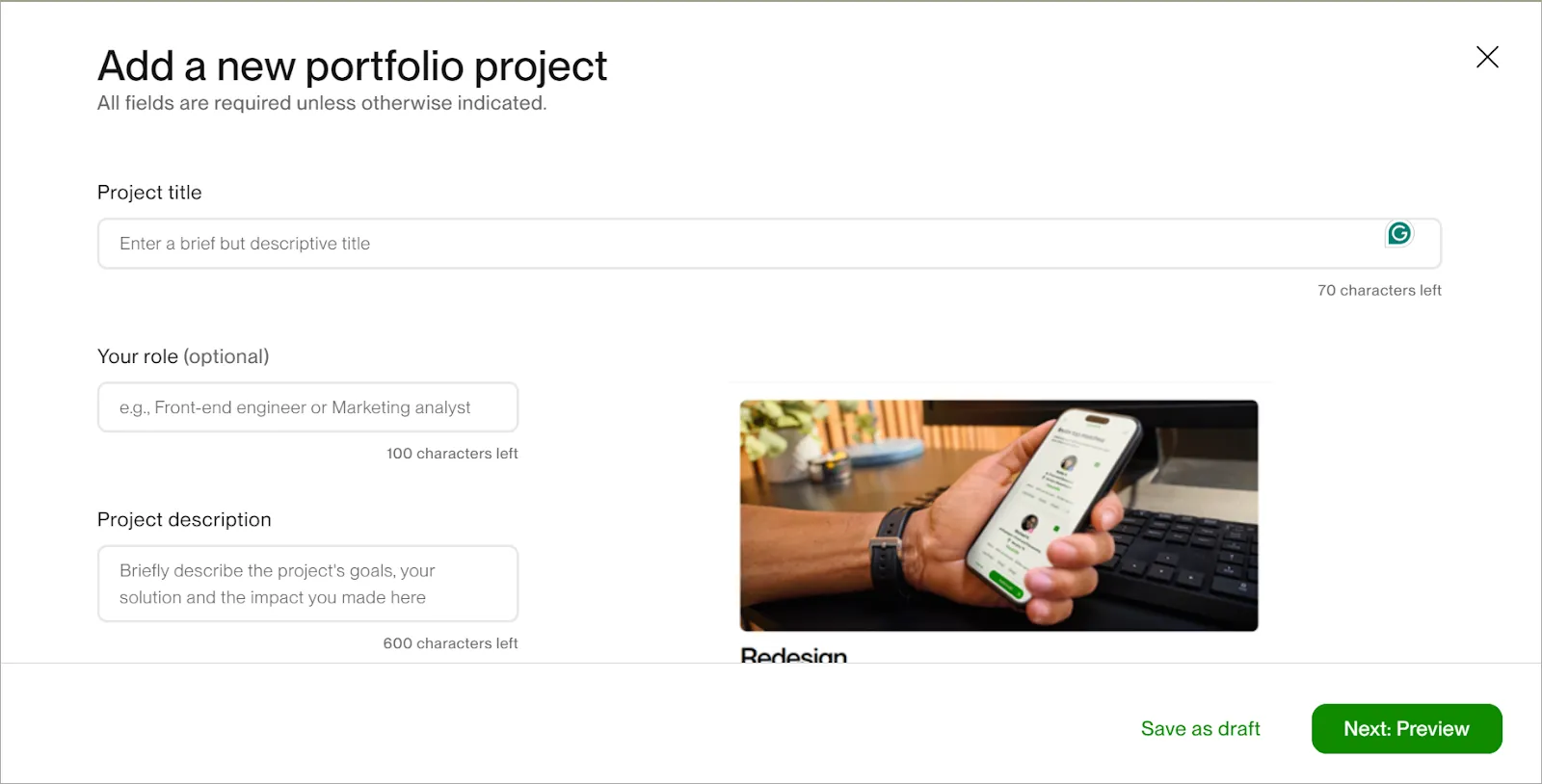
Upwork offers an area for creating your portfolio so you can showcase your best work without using another portfolio site.
- Upwork offers various ways of making money.
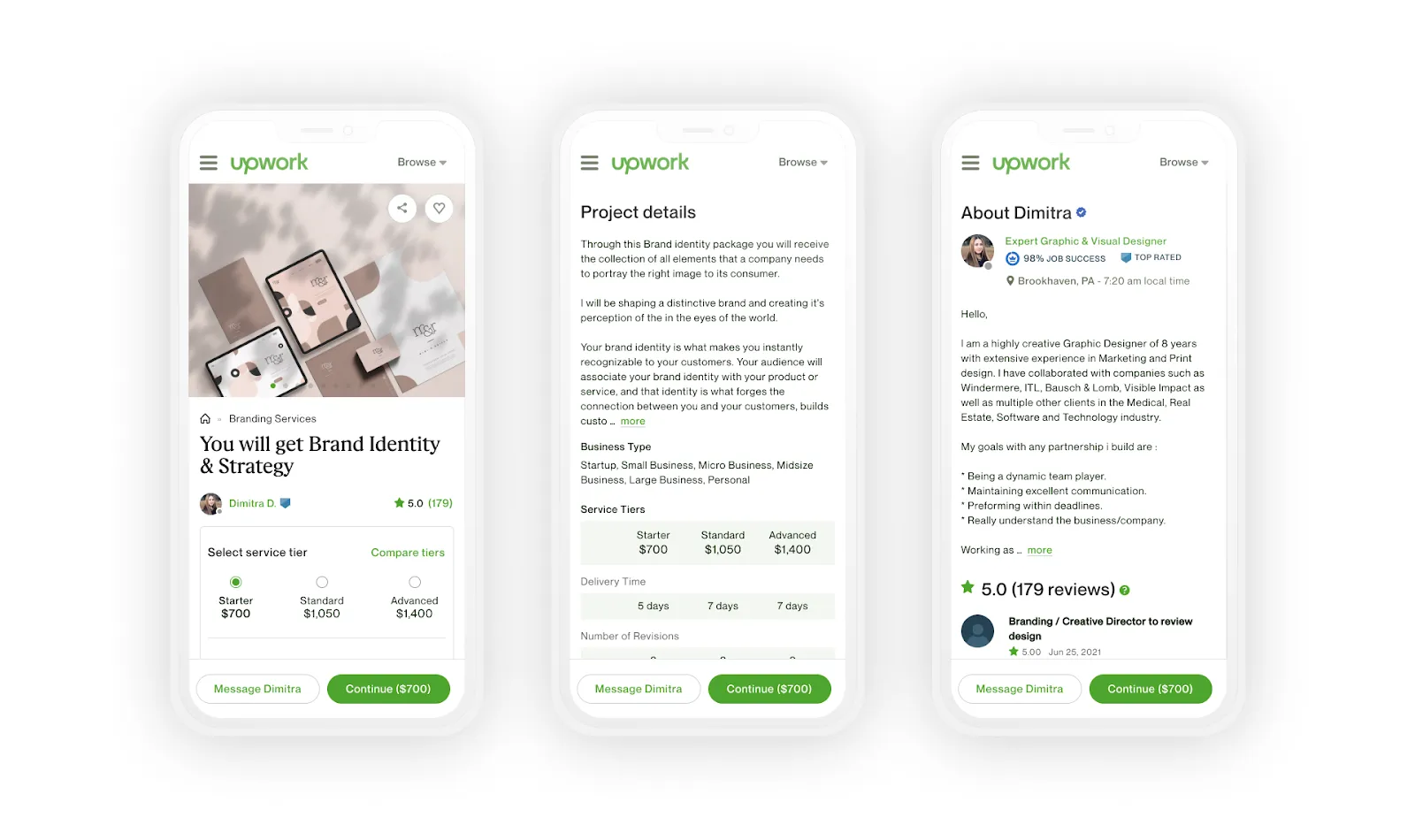
As you know, you can get hourly and project-based work on Upwork. But another feature you might not know is “Project Catalog”. This is a feature you’ll recognize from Fiverr as well.
Now you’re able to list fixed-price service packages on Upwork, just like Fiverr’s Gigs, and let clients find you.
Top features for businesses
- Upwork UMA AI: Automatic bid assessment, fast hiring processes
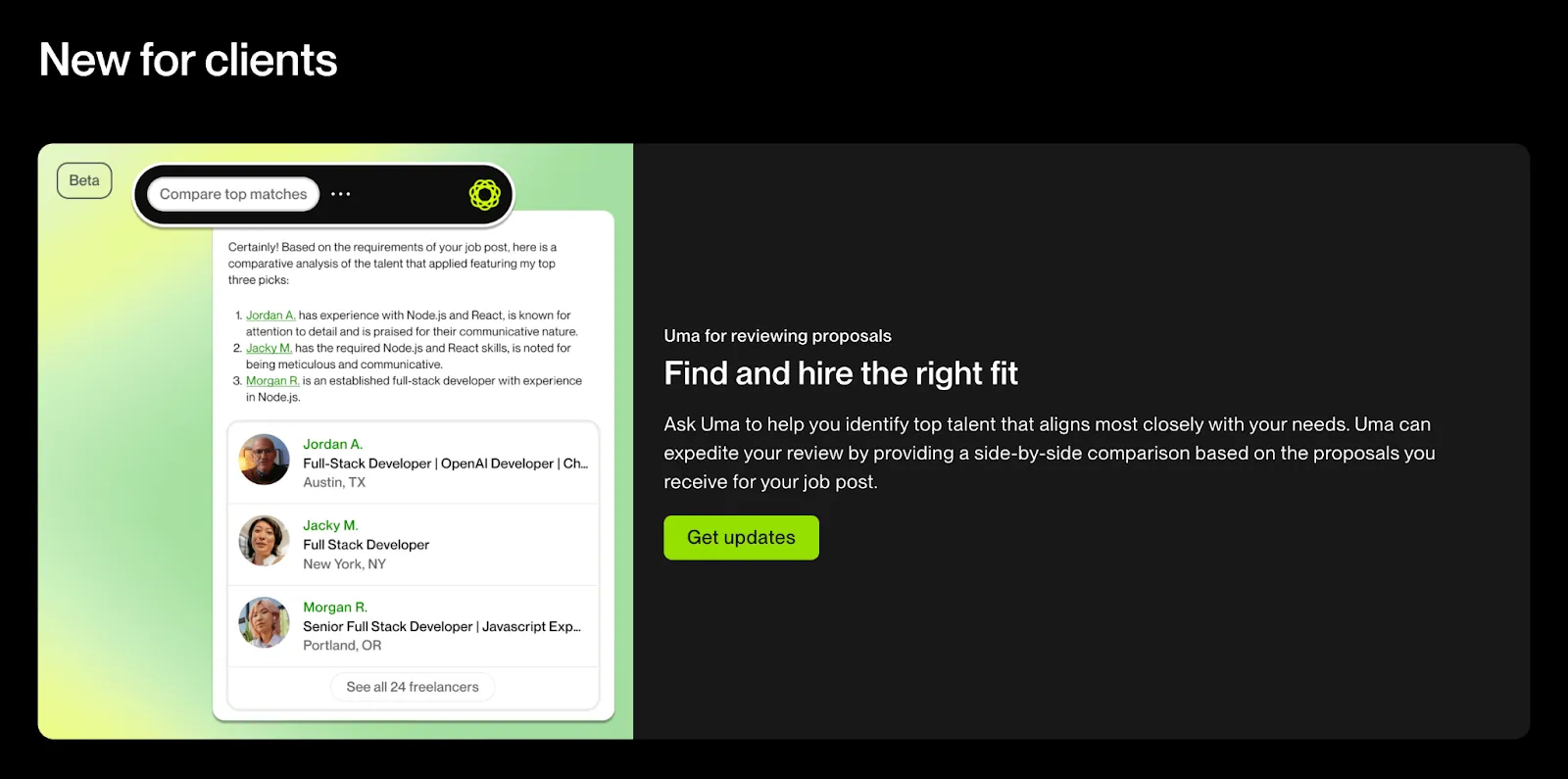
You can ask Upwork’s new artificial intelligence UMA to compare the best freelancer offers. Thus, you can hire the best freelancers in seconds instead of manually reviewing all offers.
Not only that. UMA AI’s “Job Post Generator” feature can save you tons of time.
- Payment protection: Risk-free freelancer partnerships
Your business has a limited budget and you don’t want to risk your money? You’ll be happy with Upwork’s payment protection policy for clients.
How does it work? Your payment is not transferred directly to the freelancer. Upwork waits for you to receive and approve the project. However, if you do not approve it within 14 days, it is automatically approved and transferred to the freelancer.
- Hire your favorite freelancers full-time
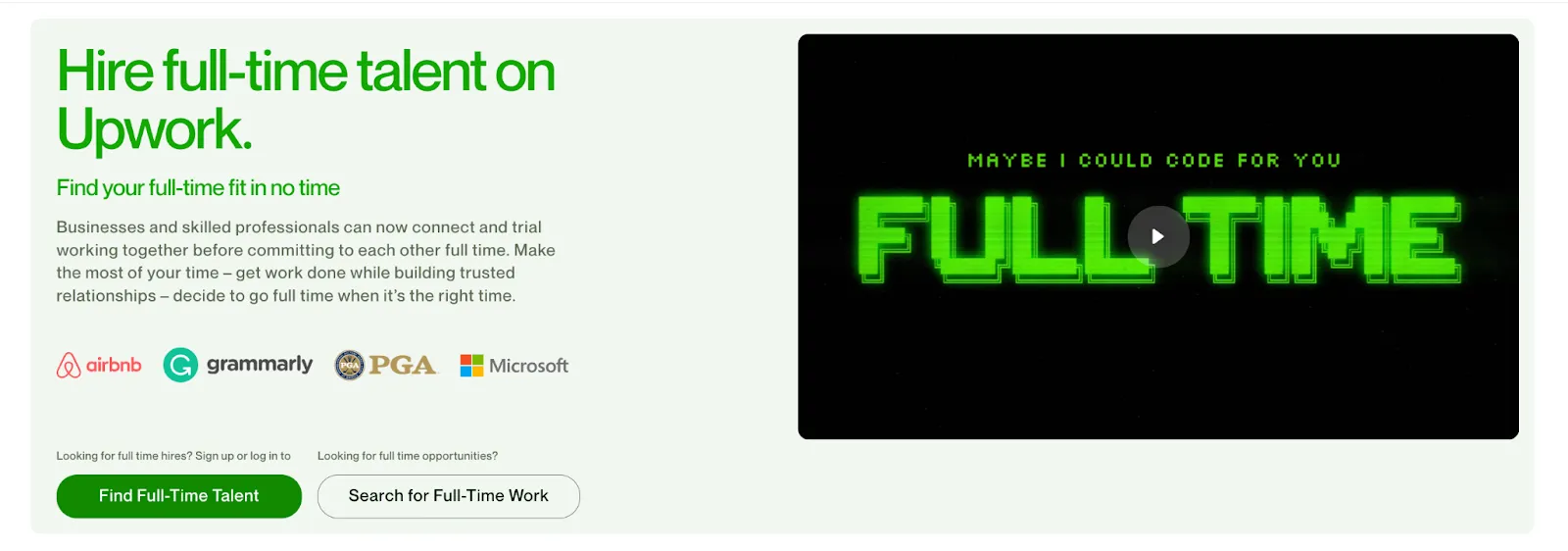
While Upwork is a freelancing platform, it offers flexible solutions for every need. As a business, you can hire the most talented freelancers full-time by organizing a meet-and-greet with them.
Advantages of Upwork
For freelancers:
- Professional and corporate customers
- 3 different types of earnings: Hourly, project-based, and project catalog
- Higher earnings compared to other sites
- UMA AI support to make bidding easier
- Ability to set working hours
- The chance to effortlessly build a portfolio
- More stable earnings
- Long-term customer agreements
- Risk-free working with Upwork payment protection
- iOS/Android compatible mobile application
For businesses:
- Senior freelancers
- Time saving with artificial intelligence support
- Hourly and project-based projects
- Project Catalog for fast purchasing
- Payment protection
- Full-time hire
Disadvantages of Upwork
For freelancers:
- 10% fee for each project
- Not suitable for beginners
- Competition is fierce
- Institutionalism can be boring
- Limited “Connects” rights
For businesses:
- Customers pay a 5% service fee
- Prices are higher than on other sites
- Service quality can be inconsistent
You can land a freelance Gig pretty much anywhere—through an online platform, by connecting with local people and companies, or even just from a post on LinkedIn.
Use Ruul to keep track of all your contracts and manage your solo work with minimum effort!
12 Top Upwork Alternatives
1. Fiverr
What is Fiverr?
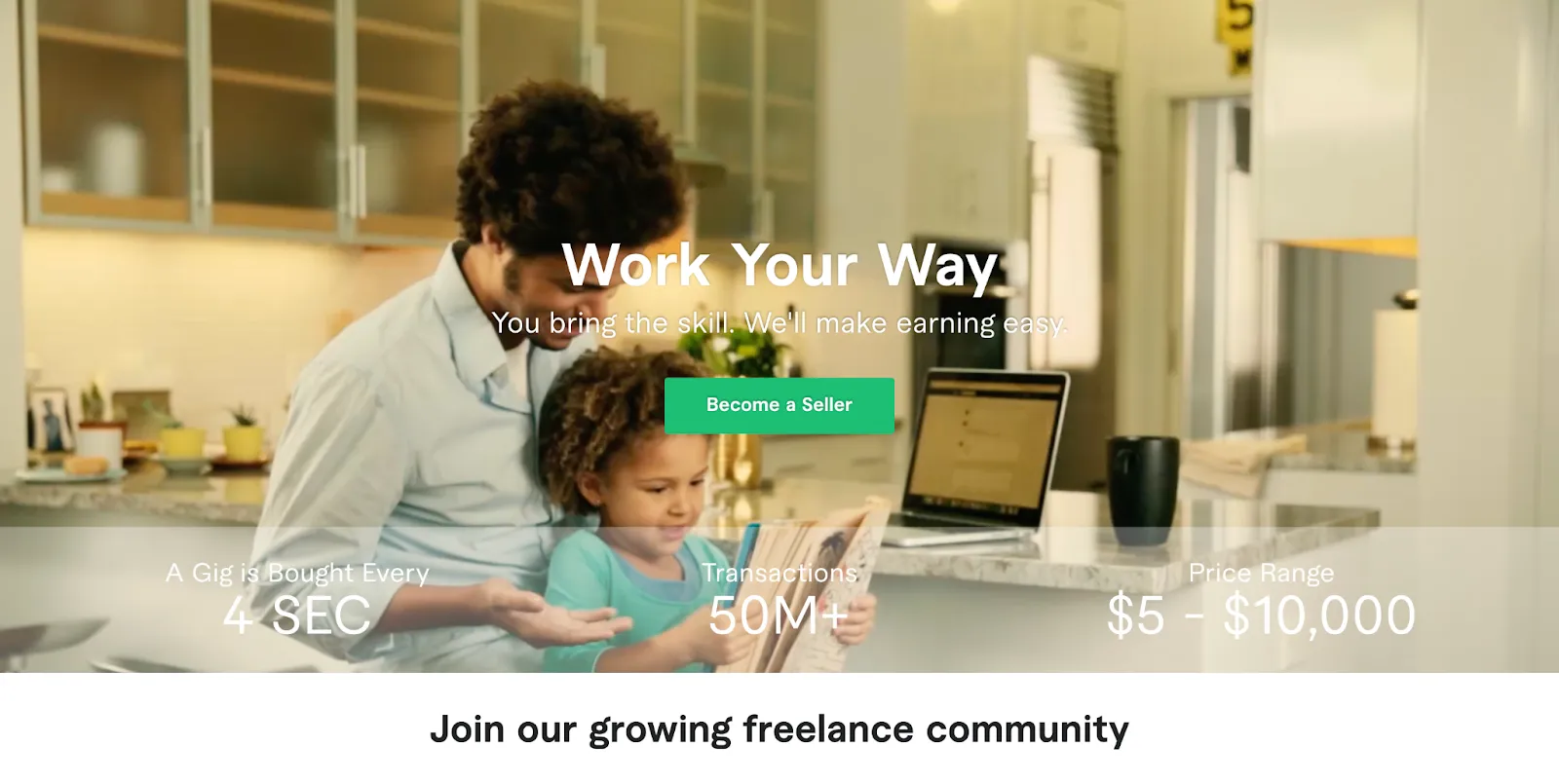
Fiverr is famous, you probably have heard about it.
The platform supports over 700 categories - probably at least one of them covers you. The popularity of Fiverr is not a surprise because they don’t really leave any in-demand freelancing service out. High five to Fiverr, for that.
Here you create and sell Gig service packages - this is a big difference between Upwork and Fiverr.
Advantages of Fiverr
- Registration takes a few minutes
- Gig creation in just a few steps - for free
- The chance to create a portfolio easily - for free
- There are 3 different Gig levels: Basic, Standard, Premium
- iOS and Android app available
Disadvantages of Fiverr
- A high fee of 20%
- Only service packages
- No hourly work and no project-based work
- Additional effort needed to stand out
- You have to wait for customers to come
Fiverr vs Upwork
Fiverr is unrivaled in simplicity and speed. Upwork caters to freelancers who are used to corporate clients and corporate companies looking for more professional people.
Also, while the fee on Fiverr is 20%, it’s half (10%) less on Upwork. If the fee is important to you, Upwork wins.
See a complete comparison here: Fiverr vs Upwork
2. Freelancer.com
What is Freelancer.com?
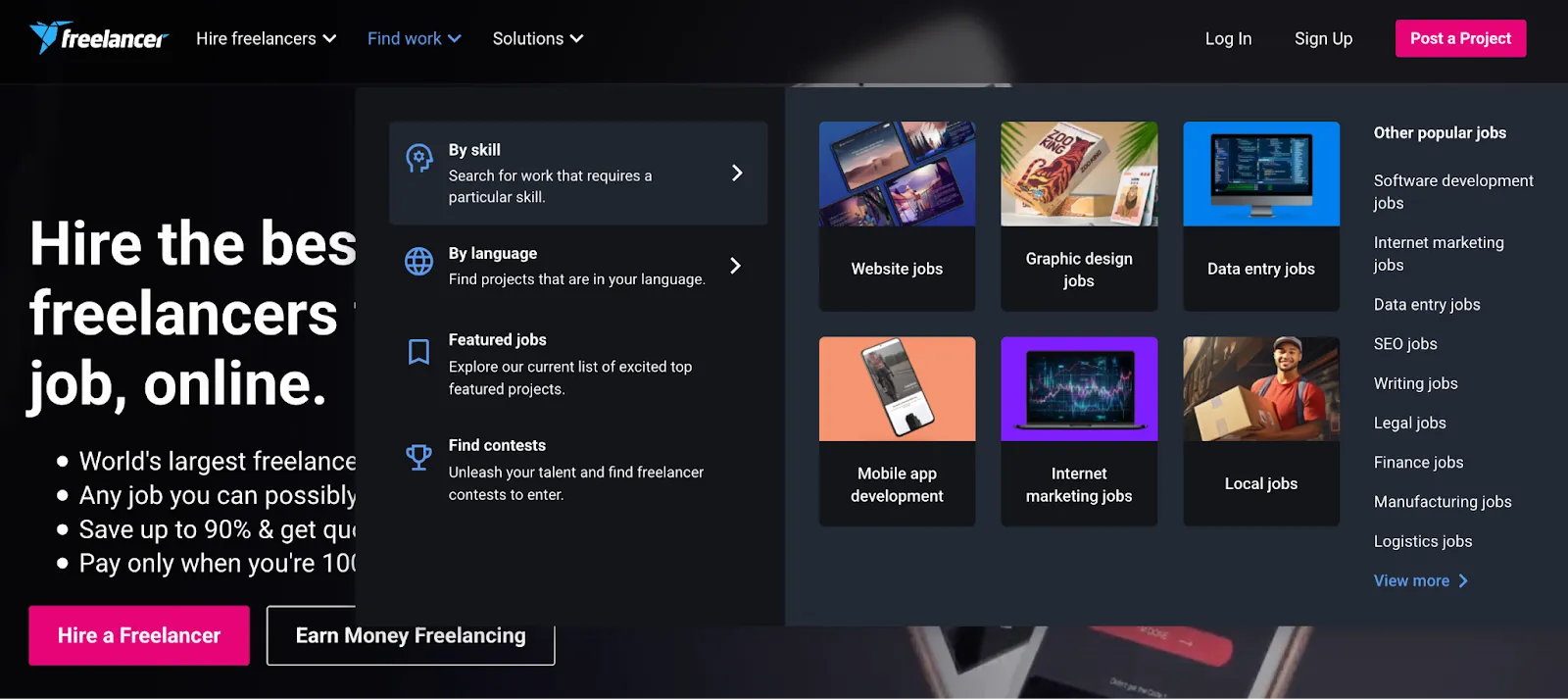
One of Upwork competitors is Freelancer.com, which ranks among the top three largest freelance marketplaces. Similar to Upwork , Freelancer.com operates on a bidding system where freelancers compete for projects.
With over 2,700+ service categories, it even offers a wider variety of services than Upwork.
However, the Freelancer.com interface is more complicated compared to other platforms, making it challenging for beginners.
Competition is fierce, and finding your first client can be tough. Spam is present on most platforms, but it seems to be more here.
Advantages of Freelancer.com
- Free registration
- Portfolio creation
- Showcasing skills
- Large freelancer network
- Wide customer base
- iOS and Android app
- Payment protection for freelancers and clients
- Profile reviews for freelancers and clients
Disadvantages of Freelancer.com
- 5% fee for freelancers
- 3% service fee for clients
- More complex interface
- High rate of competition
- Spam messages widespread
- Below-market wages
Freelancer.com vs. Upwork
Both platforms charge a 10% fee for freelancers, but Upwork charges clients 5%, while Freelancer charges 3%.
When it comes to user experience, Upwork feels more professional, and its interface is more beginner-friendly. In contrast, spam messages are more common on Freelancer.com.
Lastly, Upwork’s UMA AI helps users save hours of work with its efficient features.
For a more in-depth look at comparison of Freelancer.com and Upwork, check out our blog.
3. Toptal
What is Toptal?
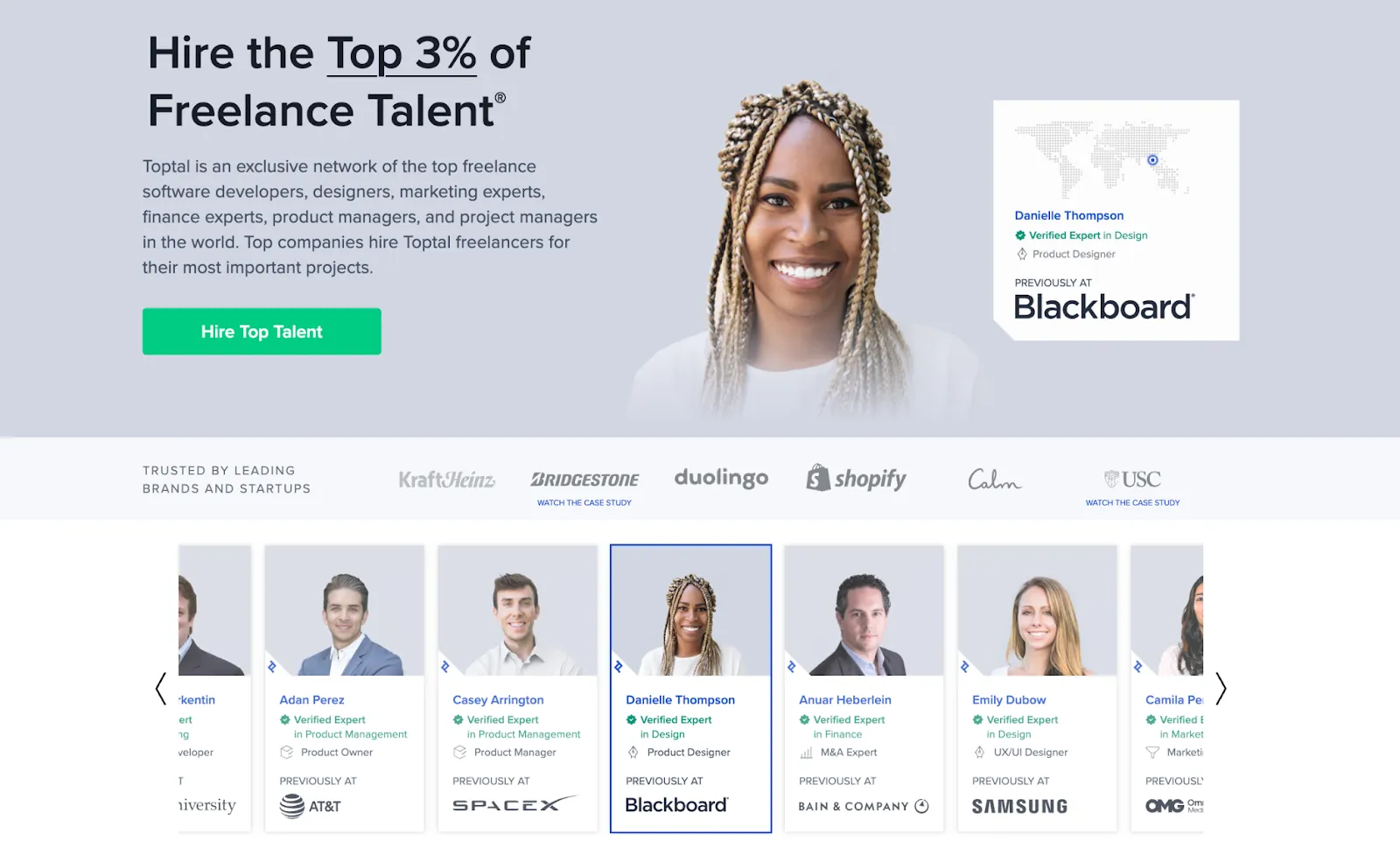
Unlike the sites we just mentioned, Toptal requires an application process. Only the top 3% get accepted.
Toptal promises to match businesses with the right freelancer within 48 hours, meaning you can find work quickly once you’re in.
The best part is that Toptal connects you only with high-quality clients, ensuring you’re assigned to suitable projects efficiently.
Advantages of Toptal
- Only the top 3% of freelancers
- High-budget clients
- Experts in Blockchain and AI
- Recruitment in 3 steps, within 48 hours
- Serving 140+ countries
Disadvantages of Toptal
- Difficult to enter (top 3%)
- Not for beginners
- Payment required for talent search
- Higher prices compared to alternatives
Toptal vs. Upwork
Toptal offers a very advantageous environment for talented and professional freelancers to move away from the low-price market.
However, it is not possible to start directly like Upwork. You need to go through the application process and be among the top 3%.
The best freelance talent for high-budget businesses can be found here. However, looking at alternatives may be costly for you, as there is a fee for talent search and freelancer payments are high.
Also see:
4. PeoplePerHour
What is PeoplePerHour?
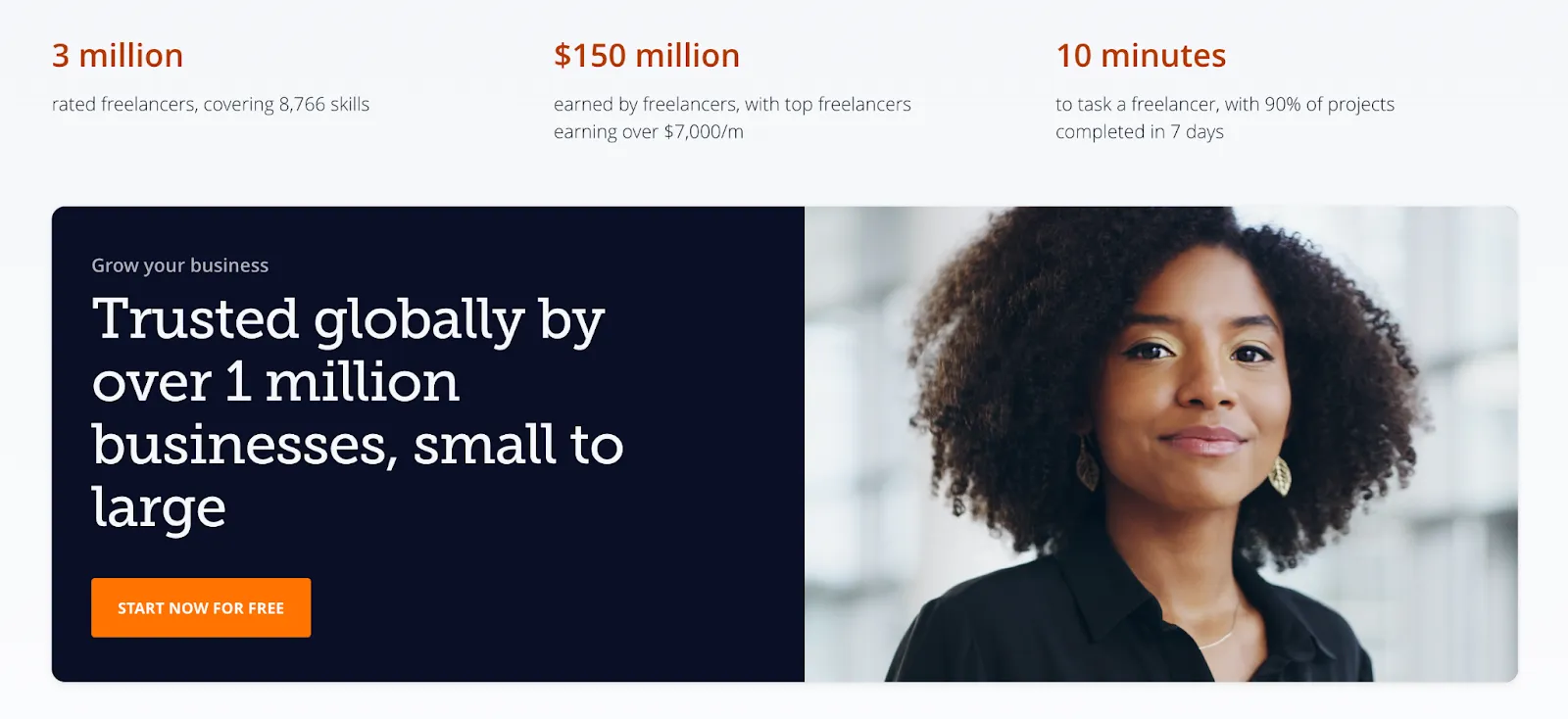
UK’s top platform for freelancers. If you want to become a certified freelancer, you can work here. However, you have to apply and be chosen to be in.
In addition to hourly jobs, there is another plus. You can create and sell fixed-price packages familiar to Fiverr.
Advantages of PeoplePerHour
- AI-supported project matches
- Careful recruitment process
- High-quality freelancers and clients
- 24/7 platform support
- Payment protection for freelancers and clients
Disadvantages of PeoplePerHour
- The application process is challenging
- Supported only hourly work and service packages
- 15 offer limit (additional fee for more)
- £250 under 20% fee
- £250 to £5000 7.5% fee
PeoplePerHour vs. Upwork
Joining PeoplePerHour is more challenging than Upwork, but it offers higher earning potential. When it comes to fees, Upwork applies a flat 10% fee, while PeoplePerHour uses a tiered system starting from 20% and dropping to as low as 3.5%.
5. 99designs

What is 99designs?
If you’re a freelance graphic designer, 99designs is a niche platform tailored for you. It offers an alternative to Upwork’s intense competition.
99designs operates in two ways: Competitions and 1:1 Projects.
- Contest: Clients choose a contest package ranging from $299 to $1,299, and dozens of freelancers submit their designs. The selected designer wins and receives the prize.
- 1:1 Project: Clients browse the pool of graphic designers and choose a freelancer. They provide all the design details, including the fee. If both parties agree, the project starts. At the end of the work, full ownership of the design is transferred to the client.
Advantages of 99designs
- Design competitions with fast results
- Full copyright for customers
- Various categories: Logo, website, packaging design
- 4.8 review score from 37,619 customers
- Blogs about trends and tips for designers
Disadvantages of 99designs
- For graphic designers (Not suitable for other skills)
- Costly system for businesses
- Unstable income for designers
- Graduated fee structure: Top (5%), Mid (10%), Entry (15%) level designers
- 5% fee for clients in 1:1 projects
99designs vs. Upwork
In fact, 99designs and Upwork are quite different. While Upwork covers various categories, 99designs focuses exclusively on graphic design.
Their fee structures are also different. Upwork charges a flat 10% fee, while 99designs uses a sliding scale for freelancers. Clients on 99designs either pay a 5% fee for 1:1 projects or buy a contest package starting from $299 to $1,299.
6. DesignCrowd
What is DesignCrowd?
DesignCrowd is actually a good alternative to 99designs. Clients start a project. Other freelancers quickly create and submit their designs. The design chosen by the client is the winner, and the project is paid to the owner of the winner’s design.
Typically, when a new project is started, between 25 and 100 designs are sent. While this variety of designs is great for client profiles, you should also be aware that it increases competition among freelancers.
Advantages of DesignCrowd
- Free registration
- Best graphic designers
- Broad design categories
- Earning money with fun contests
- Money-back guarantee
- Full copyright of the selected design
Disadvantages of DesignCrowd
- High competition for freelancers
- Uncertain design quality for customers
- 15% fee from designer payments
- An additional $129 on top of the package for customers
DesignCrowd vs. Upwork
DesignCrowd is a niche platform for graphic designers, unlike Upwork, which covers all freelancing fields.
It operates on a competition-based model, creating a highly competitive environment where only the winning design is rewarded. In contrast, Upwork offers a more structured environment with hourly or project-based work.
As for commission fees, Upwork typically charges 10%, while DesignCrowd charges 15%.
7. Guru

What is Guru?
To date, Guru has completed over 1 million jobs and paid $250 million to freelancers.
Here’s how it works: Clients post a job ad, and freelancers apply. The client then hires based on the freelancer’s review scores, portfolio, and qualifications.
Advantages of Guru
- 99% customer satisfaction
- $250 million in payments so far
- Small fee for freelancers: 5%
- Minimal fee for employers: 2.9%
- Recurring payments enabled
- Hourly or project-based work options
- Payment protection system
- Team-building features
Disadvantages of Guru
- Manual offer evaluation
- No AI support
- No mobile app
- Lack of support
Guru vs. Upwork
Guru and Upwork are similar. However, while Guru seems to stand out for its low commission - don’t let that fool you. Keep in mind that Upwork forces you to buy Connects.
Upwork ranks first in user experience because UMA AI does so much of the work. We haven’t heard of a feature like that in Guru yet.
8. SimplyHired
What is Simplyhired?
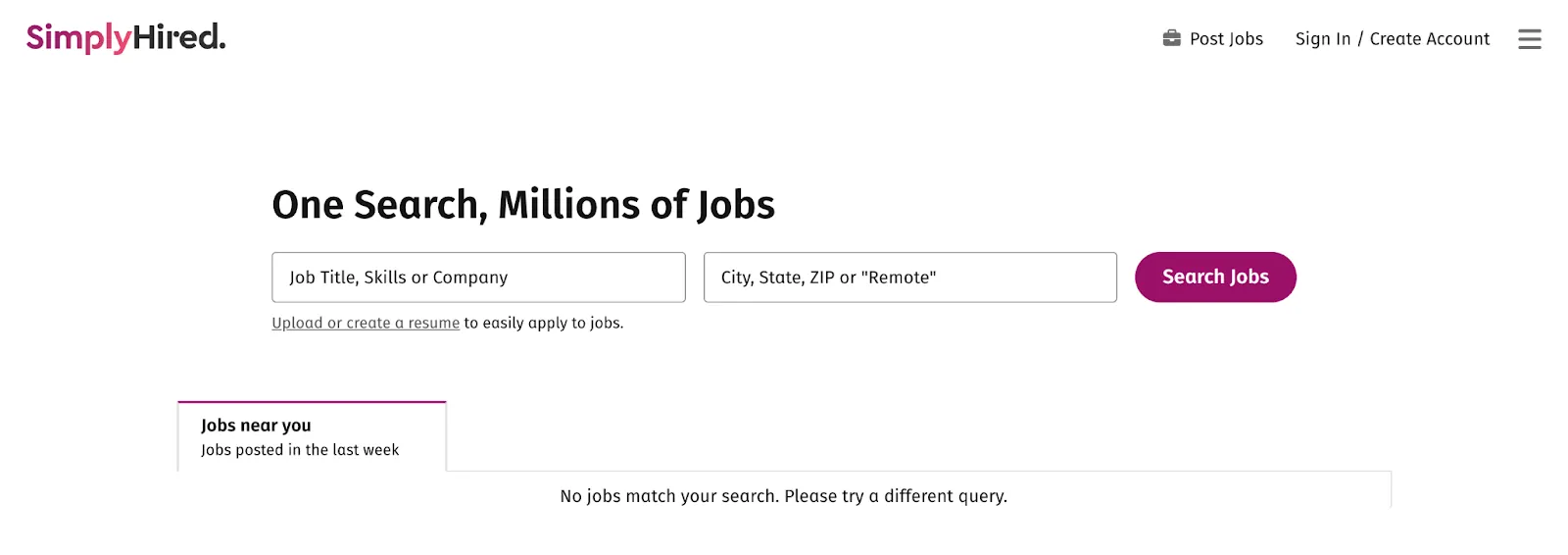
SimplyHired works as a job search engine, listing remote, part-time, and full-time jobs instead of freelance opportunities. This approach covers a wider range of employment types.
It’s important to note that SimplyHired is not a freelancer platform. If you’re looking for local or remote jobs, it could be a good option for you.
Advantages of SimplyHired
- Completely free for job seekers and employers
- Remote, part-time, and full-time jobs worldwide
- Simple and user-friendly site interface
Disadvantages of SimplyHired
- Not just for freelancers
- High advertising spend
- There is intense competition
- Non-guaranteed jobs
- Unregulated job vacancies
SimplyHired vs. Upwork
SimplyHired is not like Upwork because it is a job search portal, not a freelancing community. Also, unlike Upwork, there are no sign-up or service fees.
But there’s a downside: businesses’ job postings get lost in the competition. That means more advertising spend.
9. FlexJobs
What is FlexJobs?
FlexJobs offers remote, flexible, and hybrid job postings and is likely one of the cleanest job search portals you’ll ever come across.
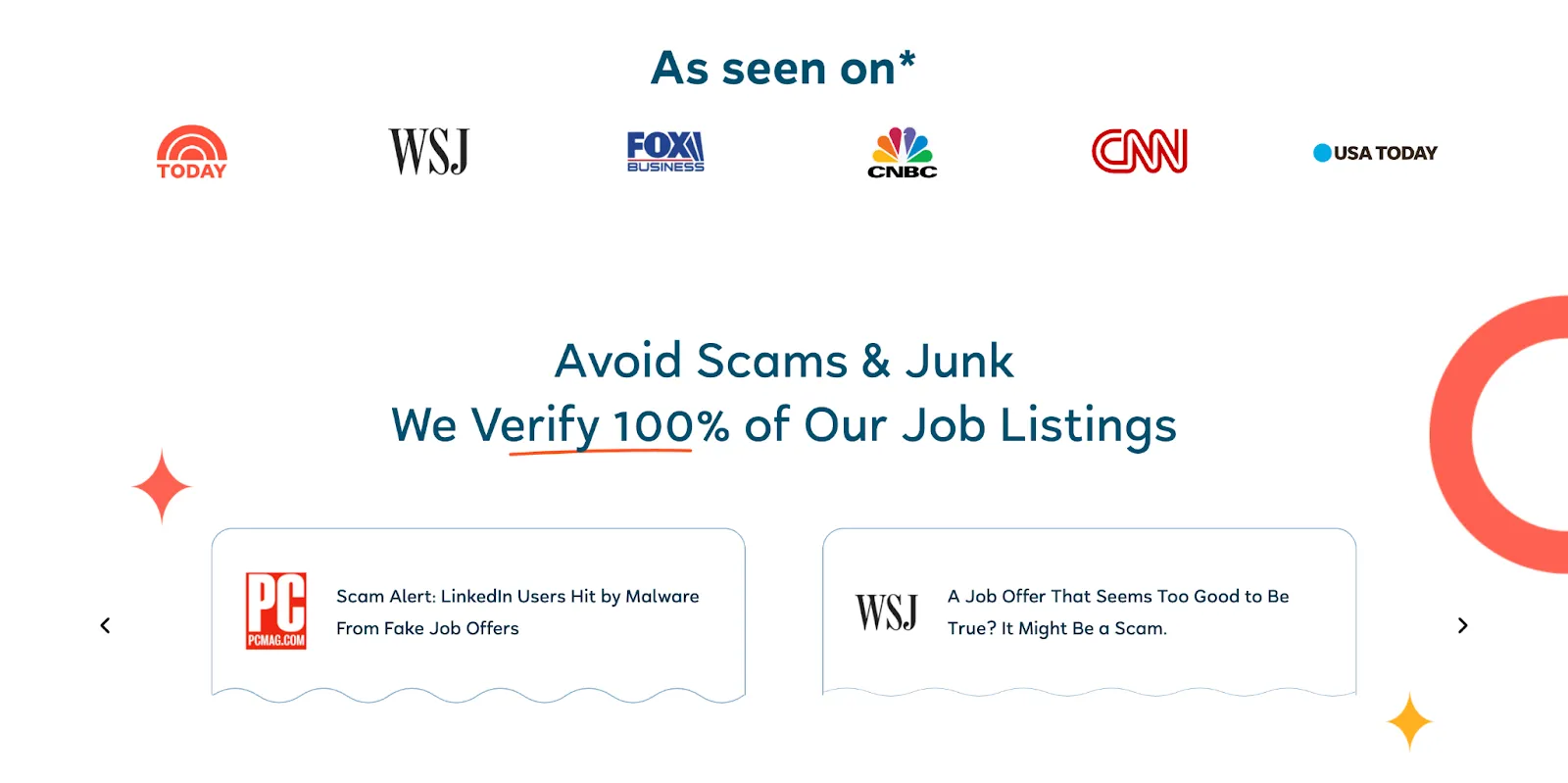
There are no distracting ads or deceptive job listings that could put your safety at risk. Each job posting is carefully vetted before being listed.
Advantages of FlexJobs
- Remote, flexible and hybrid jobs
- No scams, no spam and no ads
- High employer and job seeker score
- 100k+ job postings
- Supervised job posting
Disadvantages of FlexJobs
- Most job postings limited to the US
- Expensive for employers: $399/month
- 14 days of use for job seekers from $2.95
FlexJobs vs. Upwork
FlexJobs is not a direct freelancing website like Upwork and operates on a subscription model. To post jobs, you’ll need to purchase a subscription plan starting at $399 per month. If you want, you can check out plans starting at $2.95 for a 14-day trial.
While FlexJobs is more expensive than Upwork, you’re paying for access to quality work and the security of avoiding scams. If you’re not limited to freelancing, it’s definitely worth checking out.
10. Working Not Working
What is Working Not Working?
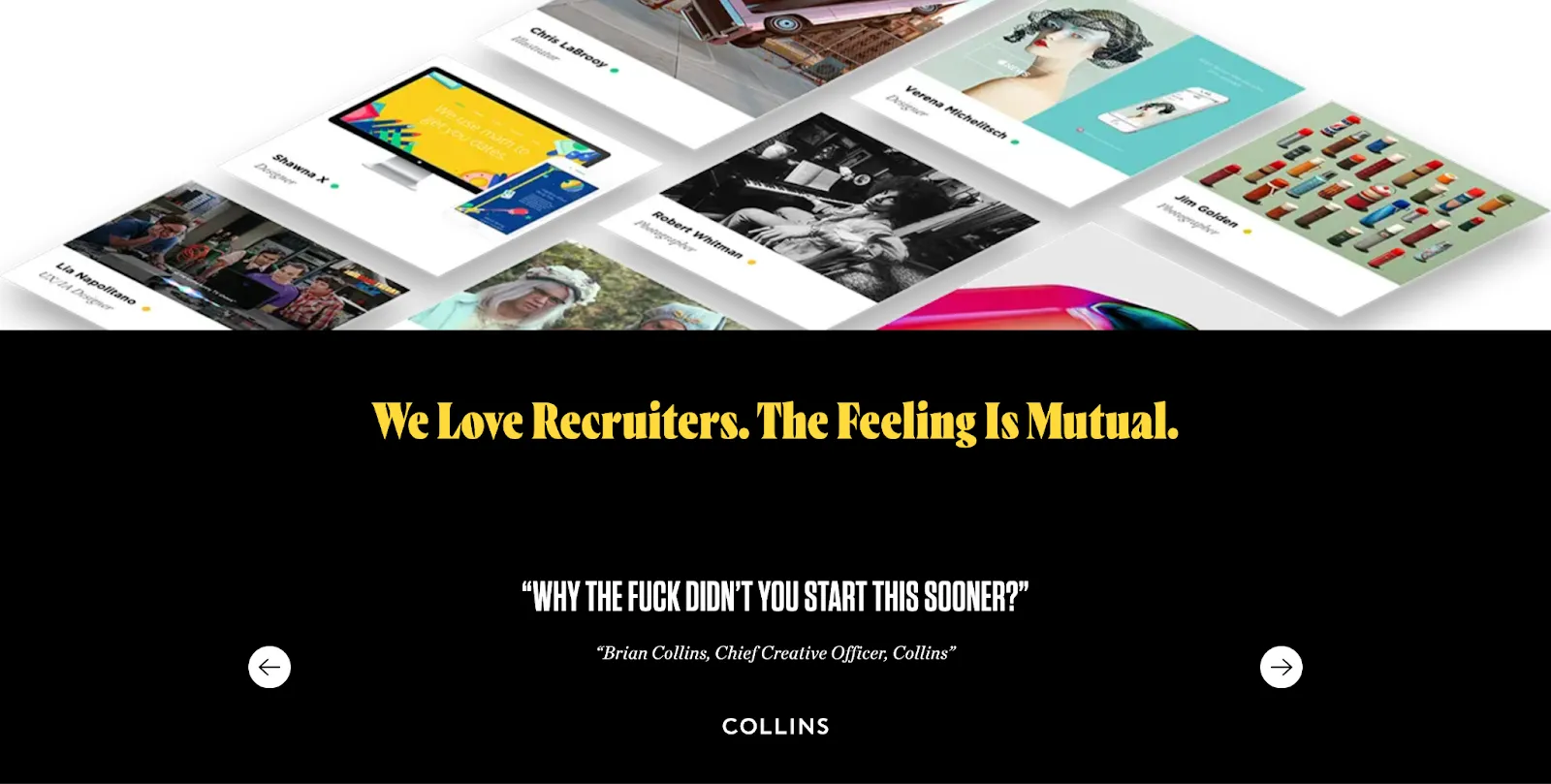
Working Not Working is a pool of over 100,000 of the best creative freelancers. By adding your portfolio, you can be discovered by the world’s most prestigious brands.
Companies can browse portfolios by filtering them by various criteria. Recruiters also use the site extensively to match companies with the right freelancers.
Advantages of Working Not Working
- 100,000+ Creative talent
- Google, Apple, and Huge trust
- Processes for efficient intake
- Free the creative mind
- Enhanced portfolio presentation
Disadvantages of Working Not Working
- $499 monthly fee for enterprises
- Site does not manage payments
- No project launch on site
- No major disadvantages
Working Not Working vs. Upwork
Upwork has strong payment policies for companies and freelancers. In contrast, Working Not Working does not manage payments or get directly involved in things like project contracts.
Also keep in mind that Working Not Working only helps you find a job, you don’t start a project on the platform. So you can think of it as a Behance-like portfolio showcase site.
11. We Work Remotely
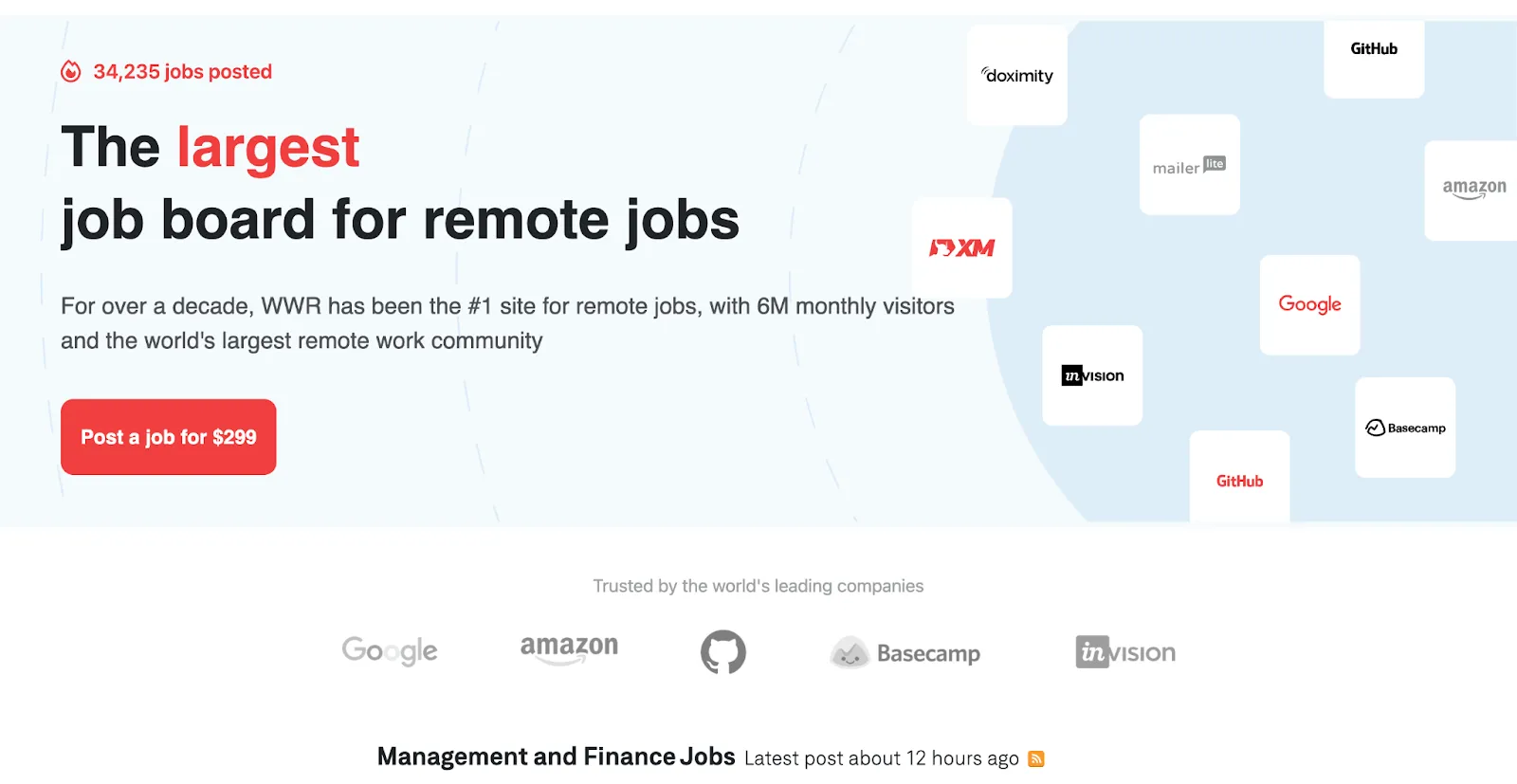
What is We Work Remotely?
We Work Remotely focuses exclusively on remote work jobs. For many years, it has been one of the largest portals for remote work. Even though it’s not directly a freelance site, if you are up to remote work it may be the best platform to check
Advantages of We Work Remotely
- The largest remote working opportunities
- #1 for remote work for over 10 years
- The choice of giants like Google and Amazon
- Blogs about remote work trends
- Additional career services like resume review
Disadvantages of We Work Remotely
- $299 job posting fee
- Limited with remote work
We Work Remotely vs. Upwork
The most obvious difference between the two sites is that Upwork focuses on freelance jobs, while We Work Remotely focuses on remote jobs.
In addition, Upwork manages everything from projects to payments, while We Work Remotely only acts as a job search portal.
12. Hubstaff Talent
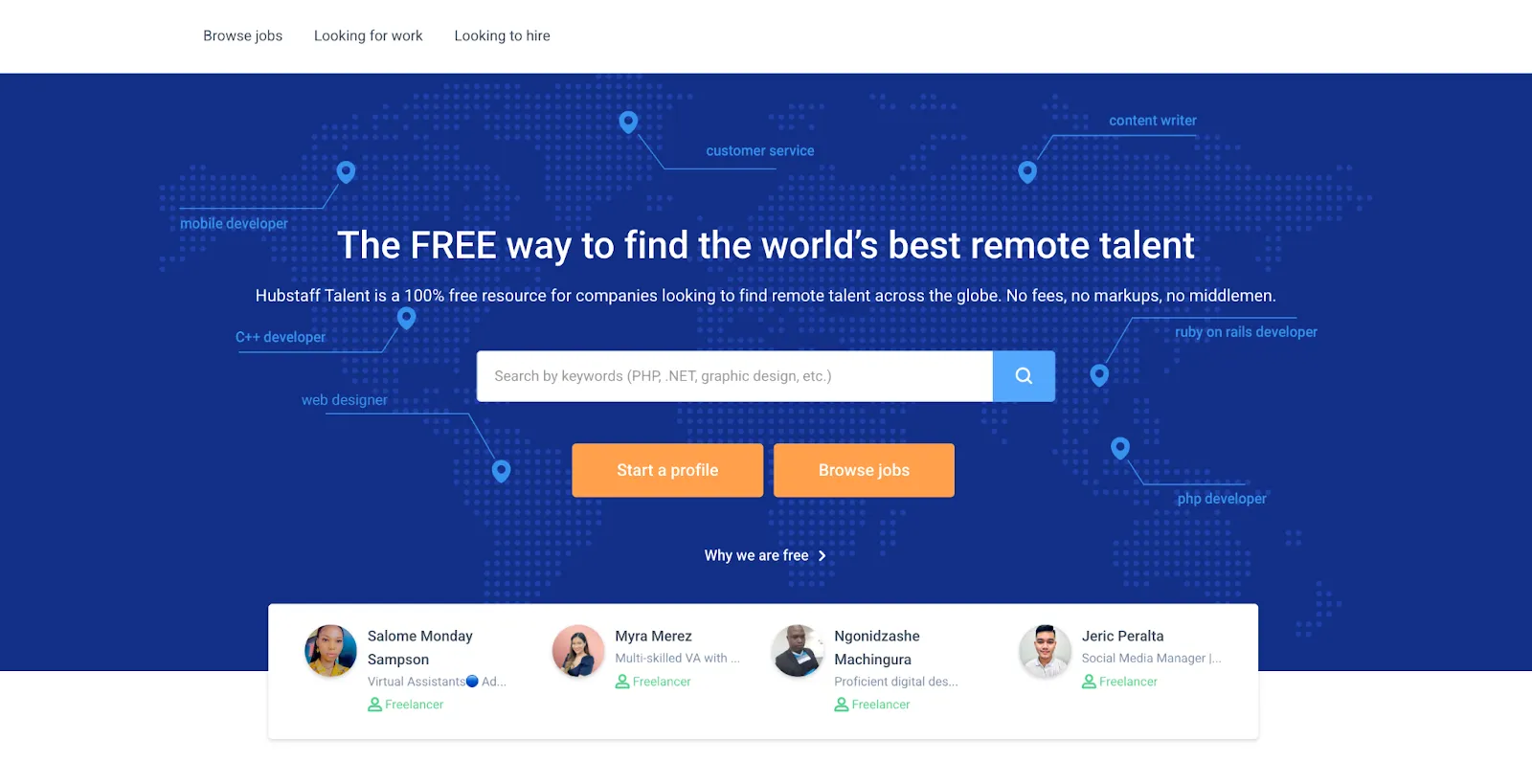
What is Hubstaff Talent?
Hubstaff Talent brings freelancers and companies together from all over the world without charging for membership, services, commissions or hidden fees. If you are a freelancer or business, you can create an account now and start searching for jobs or hiring freelancers.
Advantages of Hubstaff Talent
- Remote capabilities around the world
- A 100% free portal for businesses
- No surcharges, commissions or hidden fees
- Easy to understand and convenient interface
Disadvantages of Hubstaff Talent
- There is no service listing
- Only companies find employees
- No mobile app
Hubstaff Talent vs. Upwork
Hubstaff Talent does not resemble Upwork in the way it works. Instead, it has more in common with We Work Remotely and FlexJobs.
Also, while Upwork charges commissions to freelancers and companies, Hubstaff Talent charges nothing.
To sum up on Upwork Alternatives
We agree, Upwork is really successful among freelance platforms. But… Charges a 10% fee.
If any feature of Upwork is a red flag for you, the list above is made up of the best. Feel free to take another look and make up your own mind.
Evaluating the alternatives listed by Upwork, and even trying them out as a real user, can help you find the freelance site to make your day.
And also, use Ruul to avoid getting overwhelmed by
- invoicing,
- tax management, and
- payment collection.
Try our pay-as-you-go feature and keep calm, even if dozens of financial work needs to be done.
Related articles
7 steps to become a freelance web developer
WorkApr 5, 2026
What Are The Essential Terms Every Freelancer Should Know
WorkApr 6, 2026
What Is Lemon Squeezy? Full Guide For Freelancers And Creators
WorkApr 22, 2026
Best apps for freelancers: A comprehensive guide
WorkApr 3, 2026
Lemon Squeezy vs Gumroad
WorkApr 22, 2026